Prepared by:
Loay Abu Rukbeh Hadeel Al-Assaf Lujain Al-Btoosh
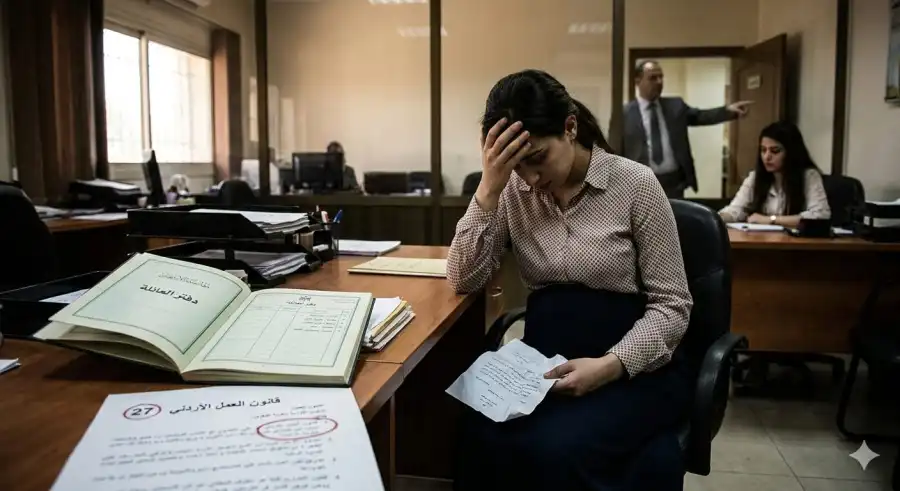
Behind the doors of economic establishments and private schools in Jordan, silent battles unfold, with working women as their victims. Here, the anticipation of a new baby is not celebrated; rather, it is viewed as an "imminent threat" to an institution’s budget. In this investigation, we present stories of women who faced professional exclusion because of motherhood and reveal the deep gap between "decisive" legal texts and a practical reality that leaves female workers to confront their fate alone.________________________________________Circumventing the Law: The Trap of Salary Reduction and Deprivation of Social SecurityIn the story of Ramia (42), we find a more complex pattern of abuse. A teacher who had spent three years at her school, she was presented at the start of the academic year with a choice of "compliance"; the administration informed her of a decision to reduce salaries without signing new contracts. When Ramia insisted on her legal right and refused the decision, the response was retaliatory; she was asked to hand over her responsibilities the same day. Even worse, Ramia discovered that the school had stopped registering her with Social Security at a carefully chosen time, stripping her of her right to "maternity leave allowance" and "childcare allowance." Ramia says bitterly: "They did not just dismiss me; they cut off the only safety rope I was waiting for so that I could care for my upcoming child."________________________________________Discrimination at the Door: The Family Book as a Barrier to EmploymentAs for Anwar (30), her story embodies "pre-emptive professional execution." Despite six years of experience as a production worker, the "family book" was the sole obstacle. The job interview at a major factory proceeded positively, but once the HR officer discovered that she had an infant, her application was frozen with a harsh verbal remark: "Your performance is excellent, but having a small child means frequent absences and excuses… come back to us when your child grows up." Her case encapsulates how "motherhood" turns into a professional stigma that excludes women from the labor market before they even set foot in it.________________________________________A Hostile Work Environment: When "Pushing Out" Becomes Administrative PolicySujood (26) did not know that the joy of expecting her first child would mark the beginning of the end of her career at a private school in Amman. She recounts the details of the "professional siege" she experienced: "The administration began assigning me tasks that required doubled physical effort. I felt extreme exhaustion while pregnant, but there was no consideration for my health." There was no formal warning, only an escalating pace of pressure that Sujood describes as "preparation for removal." The scenario was completed after her return from maternity leave; she worked only a few days before receiving a notice of termination under the clause of "non-renewal," only to discover that the "replacement" had effectively settled into her position, proving that the dismissal decision had been premeditated from the moment she announced her pregnancy.________________________________________What Do the Numbers Say? The Gap Between Silence and Official DataThese cases do not come in isolation from a statistical reality that confirms the depth of the crisis. This investigation directed inquiries to the spokesperson of the Ministry of Labor, Mohammed Al-Zayoud, regarding the mechanism for handling complaints related to dismissal linked to pregnancy. Based on the inquiry submitted on 29/1/2026, a written response was received from the Central Inspection Directorate on 1/2/2026, revealing important numerical data:● Registration of 20 complaints related to explicit dismissal during maternity leave.● Registration of 48 complaints from female workers related to arbitrary dismissal after filing a complaint or undergoing disciplinary action.These figures do not reflect the true scale of the problem. According to data from the Department of Statistics for the first quarter of 2025, the unemployment rate among women in Jordan reached approximately 31%, compared to about 18% among men. Data from the Social Security Corporation for 2023 also indicate that only around 11,000 women benefited from maternity leave allowance, a small number compared to the size of the female workforce.Globally, these findings intersect with the World Bank report "Women, Business and the Law 2024," which pointed to the continued gap between legislation on paper and actual implementation, confirming that women remain the most professionally affected after childbirth, with nearly 45% of women in recent studies reporting negative changes at work during pregnancy.________________________________________Between Text and Application: What Does Jordanian Law Say?Although the previous cases appear similar in their catastrophic impact on women’s lives, the Jordanian legal framework explicitly provides protection for working women during pregnancy and after childbirth. However, the investigation reveals a vast "chasm" between mandatory legal text and field practice.Article (27) of the Jordanian Labor Law No. (8) of 1996 and its amendments explicitly states: "An employer may not terminate the service of a pregnant worker starting from the sixth month of her pregnancy or during maternity leave." This text, which is supposed to be a protective shield, collides with the reality of exploiting the loophole of "expiration of contract term" or pushing the worker to resign under professional pressure.Article (70) of the same law also affirms a fundamental, non-negotiable right: "A working woman is entitled to maternity leave with full pay before and after childbirth, totaling ten weeks, provided that the period after childbirth is not less than six weeks." In an attempt to ensure women’s access to justice without financial obstacles, the legislator stipulated in Article (137/d/1) the exemption of workers from court fees in labor cases, while Article (138) regulated limitation periods so that certain rights are not heard after two years from the date the right arose, which may cause many women to lose their rights if they delay resorting to the judiciary.Labor law attorney Mukhtar Al-Shatrat explained in an interview conducted by the investigation that the texts are clear in principle, but the issue lies in the "rules of evidence." Al-Shatrat confirms that any termination proven to be linked to pregnancy or maternity leave constitutes a violation of the law, and that modifying salary or essential working conditions without the worker’s explicit consent does not align with the provisions of the Labor Law. He also highlights a serious issue: suspending a worker’s Social Security registration. He points out that entitlement to maternity leave allowance is organically linked to continued insurance coverage, making the timing of suspension a "malicious act" that deprives the worker of her financial rights at the very moment she needs them most.________________________________________A Rights-Based Reading: "We Document Dozens of Cases Annually"Linda Kalash, Executive Director of the Tamkeen Center for Legal Aid and Human Rights, places these violations within the context of an "exclusionary work culture." In an extended interview conducted by the investigation, Kalash said: "At Tamkeen, we document dozens of cases annually of women who were dismissed or marginalized as soon as they announced their pregnancy, but the exact number is difficult to determine nationally because many women prefer to withdraw silently rather than engage in long and psychologically costly legal battles."Kalash elaborates on patterns of violations, confirming that they are noticeably repeated in specific sectors, most notably private schools, the service sector, and small and medium-sized factories. She believes these sectors are influenced by a work culture that prioritizes "material productivity" and cost, making pregnancy viewed as an "economic burden," not only because of maternity leave paid by Social Security, but also due to the "cost of a temporary replacement" and the right to a "breastfeeding hour."Kalash reveals a harsher face of these violations: employers do not always resort to direct dismissal but instead adopt a policy of "creating a hostile work environment." This includes marginalizing the worker or assigning tasks incompatible with her health condition to force her into "voluntary" resignation. She adds sharply: "We have monitored employment contracts that include clauses requiring not becoming pregnant during the period of service, which we consider a blatant violation of human and constitutional rights, and a blow to the foundations of job stability for Jordanian women."Kalash concludes by warning that women in the "informal sector" face an even worse fate due to the absence of any insurance or social protection, considering that the continuation of these practices is not due to the absence of legislation but to weak accountability mechanisms and the repetition of a pattern that excludes motherhood from the workplace in an undeclared manner, making the rate of reinstatement after court rulings very low.________________________________________When "Loopholes" Defeat the Justice of Legal TextsThe stories of Sujood, Ramia, and Anwar do not end with the conclusion of an inspection round or the issuance of a delayed judicial decision; they reflect a structural flaw in the "filtering" of women from the labor market as soon as they exercise their natural right to motherhood. While Jordanian legislation provides texts protecting pregnant women, reality reveals that the "family book" still functions as a "guillotine" for ambition, and that fixed-term contract loopholes and indirect pressures have become stronger than the authority of the law.The continuation of this pattern of systematic exclusion, in light of a female unemployment rate exceeding 31%, places oversight bodies before a moral obligation before a legal one. The protection provided by Article (27) remains "ink on paper" unless accompanied by proactive oversight that criminalizes discrimination in hiring and curbs employers’ encroachment on Social Security contributions. Until that is achieved, pregnancy in the Jordanian labor market will remain an uncalculated "professional risk," forcing women to pay the price of their career futures in exchange for their right to motherhood.